
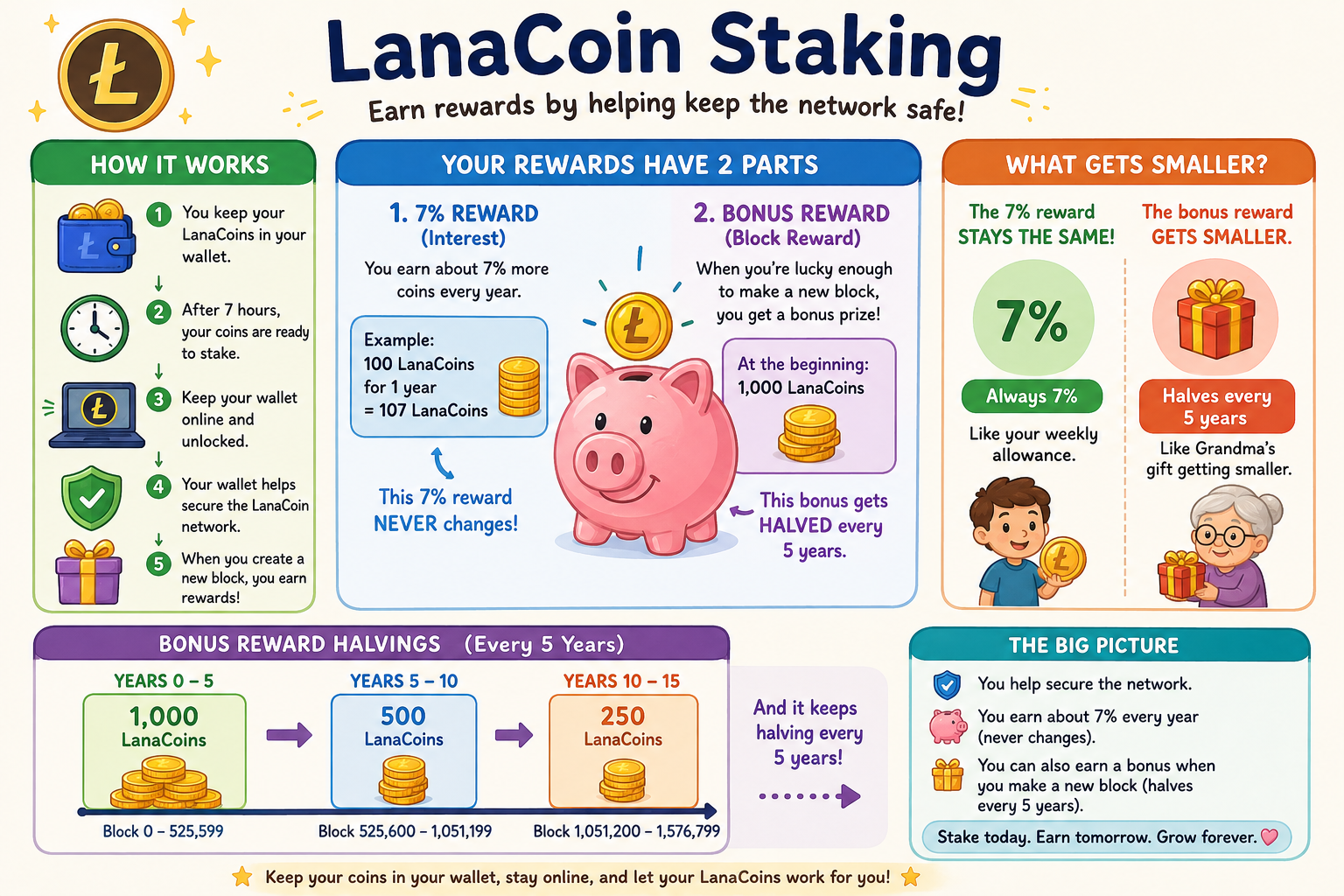
Unlike modern validator-based PoS systems (Ethereum, Cardano, etc.), LanaCoin follows the classic UTXO staking model inherited from Peercoin/BlackCoin.
The process works as follows:
- Coins remain in your wallet.
- After they reach the minimum staking age of 7 hours, they become eligible to stake.
- Your wallet must remain online and unlocked for staking.
- Every eligible coin output (“UTXO”) repeatedly attempts to solve a staking hash.
- The probability of finding a PoS block is proportional to the amount of coins being staked.
- When your wallet successfully creates a PoS block:
- your transaction is included,
- the network accepts the block,
- new LANA are minted as the staking reward.
Unlike delegated PoS, there are:
- no validators
- no slashing
- no lock-up period
- no delegation
Your coins never leave your wallet; they simply participate in block generation while remaining under your control. (Bitcointalk)
2. How staking rewards are calculated
Every successful PoS block receives two reward components.
Component 1 — Fixed block reward
Originally every PoS block earned
1000 LANA
This reward is independent of wallet size.
It is intended to guarantee that even smaller stakers receive meaningful rewards whenever they successfully mint a block.
Component 2 — Annual staking interest
On top of the fixed reward, the wallet also earns
7% annual interest
This interest is proportional to the value of the coins that created the stake.
Conceptually:
Reward
=
Fixed Reward
+
Annual Interest
or
Reward =
Fixed Reward
+
(Coin Amount × 7% × Coin Age / 365)
For example:
Stake input:
100,000 LANA
Held for one year:
Interest

100,000 × 7%

= 7,000 LANA
If that stake wins after six months:
≈3,500 LANA interest
which is then added to the current fixed block reward.
This means larger stakes earn proportionally larger interest, while every successful staking block also includes the fixed issuance.
3. Why the 7% never halves
This is one of LanaCoin’s distinctive monetary features.
Only the fixed reward changes.
The 7% interest remains constant forever.
Therefore:
| Reward component | Halves? |
|---|---|
| Fixed reward | ✅ Yes |
| 7% interest | ❌ No |
As the network matures:
1000 + 7%

↓

500 + 7%

↓

250 + 7%

↓

...
The percentage return continues to reward long-term holders, while the fixed issuance gradually declines.
4. How halvings work
LanaCoin does not halve Proof-of-Work rewards.
Instead, the halvings apply only to the fixed PoS reward.
The schedule is:
| Block height | Fixed reward |
|---|---|
| 0–525,599 | 1000 LANA |
| 525,600–1,051,199 | 500 LANA |
| 1,051,200–1,576,799 | 250 LANA |
Each interval lasts 525,600 blocks, which is approximately five years at LanaCoin’s 2.5-minute target block time. (LanaCoin.net)
5. Example staking rewards over time
Suppose you stake
1,000,000 LANA
Annual interest:
70,000 LANA/year
If your wallet finds a staking block:
Before first halving
1000
+
interest accrued
Example:
1000
+
575

=
1575 LANA
After first halving
500
+
575

=
1075 LANA
After second halving
250
+
575

=
825 LANA
Notice that the interest portion remains identical; only the fixed subsidy declines.
6. Why this design is interesting
Economically, LanaCoin separates issuance into:
A. Inflation for network participation
- fixed reward per staking block
- gradually decreases through halvings
B. Long-term holder incentive
- permanent 7% annual return
- scales with stake size
- never halves
This produces two effects:
- Early in the network’s life, the fixed reward dominates, making staking attractive even for relatively small holders.
- Over time, as the fixed subsidy shrinks, staking returns become increasingly driven by the 7% annual interest, aligning rewards more closely with the amount of capital being staked.
7. Long-term monetary policy
The issuance curve therefore evolves like this:
| Era | Fixed reward | Interest |
|---|---|---|
| Launch | 1000 | 7% |
| First halving | 500 | 7% |
| Second halving | 250 | 7% |
| Future halvings | continues halving | 7% forever |
Unlike Bitcoin, where the block subsidy eventually approaches zero, LanaCoin is designed so that the fixed block subsidy diminishes over time, but the 7% annual staking component remains a permanent source of new issuance for active stakers. (LanaCoin.net)